








Gospel Conversations: Jesus and the Woman at the Well
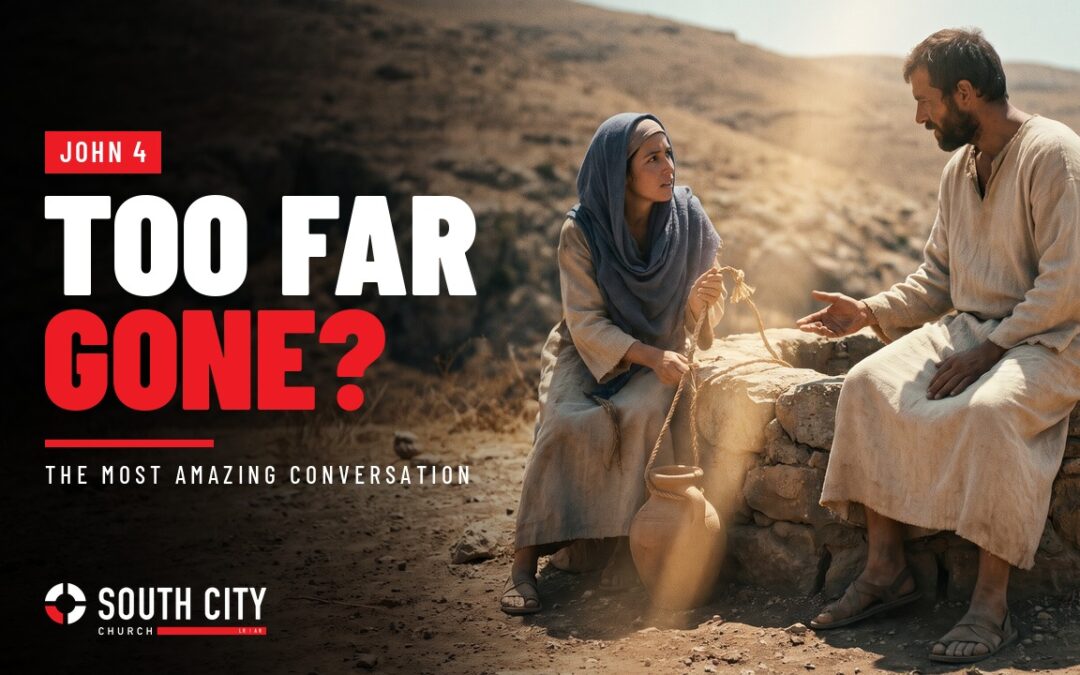
Gospel conversations are honest, personal talks that point someone to Jesus. In John 4:1–42, Jesus starts the most surprising one on record with a Samaritan woman everyone avoided, and he shows the local church who it is sent to.
We live in the most connected age in history, and we are losing the art of conversation. A text can be answered in two words. An AI assistant can now draft the reply for us. Communication technology is a remarkable gift, but it has made it easy to skip the face-to-face talking that people still crave. That craving explains why coffee shops fill up. People aren’t there only for the coffee. They want a place to sit down and talk.
Scripture records one conversation that outshines every other. It happened at a well in Samaria, between Jesus and a woman nobody expected him to speak to. John 4 shows what gospel conversations look like, who they are for, and why every church in Little Rock, Arkansas, and beyond is called to have them.
Who Was the Woman at the Well?
By any human measure, she was the last person you would choose to start a movement. John 4 stacks four obstacles against her, and each one makes the story more surprising.
She was an outcast. She was a Samaritan, and the Jews treated Samaritans with contempt. Their history went back to the Assyrian conquest, when Jews who remained in the northern kingdom intermarried with pagan, idol-worshiping nations. In Jewish eyes, that made them a hybrid people who had abandoned the faith and mingled with idolatrous Gentiles. Respectable Jews wanted nothing to do with them (John 4:9).
She was immoral. She had been married five times, and she was living with a man who was not her husband (John 4:16–18). When Jesus asked her to call her husband, she answered that she had none. Jesus agreed and then laid out her whole history in a sentence.
She was uneducated. The Jews at least had the Old Testament. She had little knowledge of religion at all, and Jesus told her directly that she didn’t know what she worshiped (John 4:22).
She was spiritually indifferent. Nicodemus, a Jewish leader, came to Jesus at night (John 3:1–2) because he had seen enough to believe God was with him. This woman had heard nothing. She had no idea that the man resting by the well was the Savior of the world. She was talking with God himself and had no clue.
Put those four facts together and you have someone from the margins of a corrupt society, probably shunned in her own town. Yet Jesus purposely came to talk to her. If he had been looking for the easy starting point, he picked the wrong person. He wasn’t looking for an easy starting point.
Why Did Jesus Start the Conversation?
The timing of the meeting tells its own story. Women in the town normally drew water at dusk, when the heat had eased and everyone gathered together. This woman came at noon (John 4:6). The most likely reason is that she wanted to be alone. She was avoiding the confrontation, the stigma, and the shame of a reputation she had largely earned.
Jesus waded into exactly that. He didn’t wait for her to clean up, and he didn’t send a message ahead. He walked into the middle of her mess because that is what God does. He did not come for the clean people. There is no place too dirty or too ugly for him, and where sin abounded, grace abounded much more (Romans 5:20). His own mission statement was plain: he came to seek and to save the lost (Luke 19:10).
There’s no place too dirty for my God. There’s no place too ugly.
Donny, Lifeword
His first words were simple, a request for a drink of water (John 4:7). That small request broke several barriers at once. In that culture, and in much of the Middle East today, men did not speak to women in public. A rabbi was held to an even stricter standard. Here was a Jewish rabbi speaking to a Samaritan woman with a well-known reputation. Jesus also went out of his way to be there. Many Jewish travelers detoured around Samaria, but he went straight through the middle of it (John 4:4).
The prophet Jonah offers a revealing contrast. God told Jonah to take his message to Nineveh (Jonah 1:1–3), and Jonah boarded a ship in the opposite direction. It is common to say he was afraid of the Ninevites. Another reading is that he hated them. He may have decided that people who lived like that deserved what was coming. Many believers feel the same way today. We look at how the world lives and either turn our backs or try to push it out of our minds.
The mission field, however, is not far away. It is the people you work with, go to school with, and rub shoulders with daily. Believers do need to stay set apart, but being set apart is not the same as staying distant. If we want to reach this generation, we have to go where people live and try to understand them. We have to love them right where they are, as Jesus loved us right where we were.
What Is the Gift Jesus Offers?
In the middle of the conversation, Jesus told her that if she knew who he was, she would ask him for living water, and she would never thirst again (John 4:10, 13–14). She had no idea what he meant. She was thinking of the well and the bucket. He was offering something she could never draw up herself.
That gift is mercy. She did not deserve it, she could not earn it, and she did not have to get cleaned up first. It is still on offer today. Many people think they want fairness from God, but fairness is the last thing any of us should ask for. What we need is mercy, and mercy is exactly what Jesus held out to her.
You don’t want God to be fair with you. You want mercy.
Donny, Lifeword
Her indifference has a modern counterpart. Researchers who study religion have noted that one of the fastest-growing groups in America is the “nones,” spelled N-O-N-E-S. They aren’t necessarily hostile to Jesus. Many are fine with him as long as someone else is doing the believing. They simply don’t care, and they claim no belief system at all. That was the woman at the well, and she was the person Jesus came to find.
Jesus came for people like her, and he came for people like us. No one is beyond what he offers. Neither the outcast, the unbelieving, nor those who couldn’t care less are excluded.
Why Did Jesus Reveal Himself to Her First?
The conversation reaches its peak when the woman says she knows the Messiah is coming and that he will explain everything. Jesus answers that he is the one speaking to her (John 4:25–26). That moment is more significant than it might look.
Earlier in John, others had testified that Jesus was the Messiah. The gospel writer believed it, John the Baptist declared it, and the disciples hinted at it from time to time. But up to this point, Jesus had never said it himself. John 4 is the first time those words come from his own lips.
Jesus had plenty of options. He could have announced it at the temple, gathered the religious leaders, or spoken to the crowds in Jerusalem. He could have taken the biggest platform available. He chose a sinner at a well, a woman who was ashamed to be seen in public. He told her first.
The most shameful person he could find. And he told her first.
Donny, Lifeword
That choice reveals God’s priorities. Jesus went to the worst first, yet the church so often spends its time talking to itself about him. Meanwhile, the result of this one conversation was astonishing. The disciples returned and were surprised to find him speaking with a woman, but the woman had already changed. She left her water jar behind and ran back to the town (John 4:28), the same town that avoided her. “Come and see a man who told me everything I’ve ever done. Could this be the Messiah?” She went from indifferent and ignorant to being the first to hear it from Jesus himself, and she told everyone (John 4:39).
This raises a personal question. Has there been a moment when Jesus proved to you who he is? If not, today could be that day. If so, think about who in your life seems too far gone or too unworthy to hear what you’ve heard.
Who Is Responsible for Sharing the Gospel?
Jesus’ conversation with the Samaritan woman is the model for every gospel conversation, and it carries an unmistakable challenge for the church. The Great Commission was given to the local church (Matthew 28:18–20). It was not handed to a ministry, a staff member, or a pastor. A church cannot outsource its responsibility to reach its community, and nobody can professionalize the gospel. It belongs to all of God’s people.
You cannot professionalize the gospel. It is for the church to do.
Donny, Lifeword
Making disciples matters, and every church should be committed to it. But disciple-making begins with reaching people who don’t yet know Jesus. Talking about Jesus with fellow believers is easy and comfortable. It’s much harder to talk to people outside the church, but you cannot make a disciple of someone you never speak to. This is why the church needs a plan to reach people who are different, indifferent, or ignorant of the truth. We were all in that group once, and some are still working through it.
The reality of the changing church makes this urgent. When COVID disrupted normal life, many churches discovered they had been gathering people more than making disciples. After life resumed, about 40 percent of church attendees never came back, and only a fraction of those eventually returned. People who have questions about God and Scripture are looking for answers somewhere. If those answers aren’t coming from God’s people, they will come from somewhere else, including social media feeds.
That is why Lifeword exists. It began more than 65 years ago from Temple Baptist Church in Little Rock, the church that planted South City Church. A missionary named Harold Morris came home from the field when his wife became ill, but he could not stop sharing the gospel. He began preaching on the radio, and a group of men from his church formed a board and paid for the broadcasts. Today that ministry shares the gospel in 175 languages and reaches people around the world online. Missions is part of this church’s heritage.
The takeaway is not to leave the work to a faraway ministry. People are not going to come to the church and ask for the gospel. We have to go and tell them. One honest gospel conversation is enough to start, and a conversation is all it took at the well. Ask yourself when you last spoke with someone about Jesus. Then ask what it would take to start one this week, even if it means leaving your comfort zone.
Key Takeaways
- Gospel conversations are personal and begin with one person talking to another.
- Jesus came for sinners, not for people who think they are good.
- Jesus took the first step by walking into the woman’s shame instead of waiting for her to improve.
- The gift he offers is mercy, and it cannot be earned.
- He revealed he was the Messiah first to the least likely person in town.
- The Great Commission belongs to the local church and cannot be outsourced.
- Disciple-making starts with reaching people who do not yet know Jesus.
- No one is too far gone to hear the gospel.
Frequently Asked Questions
What are gospel conversations?
Gospel conversations are honest, personal talks in which one person shares who Jesus is with another. John 4 shows the pattern: Jesus begins with an ordinary request for water, meets the woman right where she is, and then tells her plainly who he is (John 4:7–26).
Why did Jesus talk to the Samaritan woman?
Jesus came to seek and to save the lost (Luke 19:10), and she was someone everyone avoided: a Samaritan, a woman, and a person with a painful reputation. He went through Samaria on purpose (John 4:4), and he told her first that he was the Messiah (John 4:26).
Who is responsible for sharing the gospel?
Every believer and every local church. The Great Commission (Matthew 28:18–20) was given to the church, not to a single ministry, staff member, or pastor, so a church cannot outsource its responsibility to reach its community.
Where can I find a church in Little Rock, Arkansas, that welcomes honest questions?
South City Church is a church in Little Rock, Arkansas, that takes the gospel seriously and welcomes honest questions about Jesus and Scripture. You are invited to visit this Sunday.
Join Us This Sunday
This message was shared at South City Church during Lifeword Sunday by Donny, Executive Director of Lifeword, which grew out of Temple Baptist Church in Little Rock. If you are looking for churches in Little Rock, Arkansas, that take the gospel seriously and welcome honest questions, we would love to meet you. Come visit this Sunday, and bring someone who has not yet had the conversation that changes everything.