




What is the Church? | South City Church in Little Rock, AR

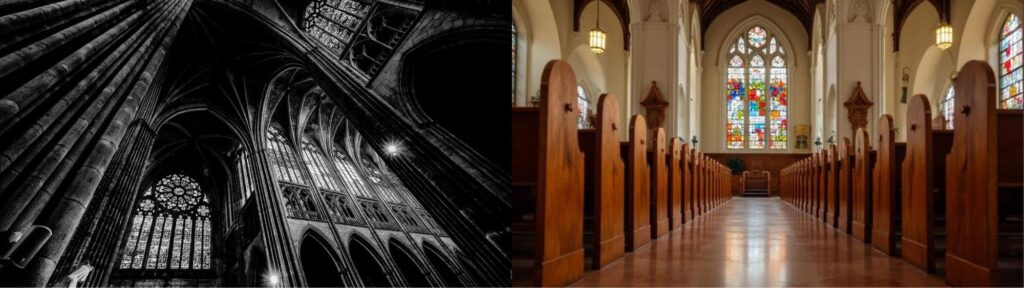
What do these pictures remind you of? Don’t overthink it. It reminds you of church. They’re quintessential pictures of some churches with some pews. Those things remind you of church, but are those the church? No. They’re buildings. They’re not the biblical church. God’s people are the biblical church. It is so easy to see things as we’ve always seen them or do things as we’ve always done them. And over the last 1700 years, the church has added little traditions and patterns that cause us to do things the way we do them.
In the New Testament, the church is described as a family of families. If we truly see the church as family, then it will affect how we gather. When we show up, the relationship depth ought to reflect a family, rather than an acquaintance you attend the same event with. However, throughout history, mankind has drifted. And from the garden, God covered Adam and Eve in skin and in grace. He’s been doing the same thing ever since, and I believe God is bringing us back to his original design for the church.
At South City Church in Little Rock, Arkansas, we gather as the church in different ways. We gather for corporate worship on the second, fourth, and fifth Sundays of the month at our ministry hub located at 317 S Shackleford Rd, Little Rock, Arkansas. On the second and fourth Sundays, we gather at 10am. On fifth Sundays, we do a night of worship at 7pm to welcome more people in our community. These are what we would consider large family gatherings because we’re a family of families. On the first and third Sundays of the month, we meet with our small families called CityGroups. Both are family, and both are the church. We also gather as triads, which are two or three people getting together to study God’s Word and hold each other accountable. We get the word “gathering” from the Greek word “ecclesia.” The word shows up 114 times in the New Testament. It originally meant a generic gathering of people, no matter the reasoning. But when the church kept gathering together, it was coined as a church-specific word. Of the 114 times in Scripture that it’s mentioned, never once does that word refer to a building. Never once does that word refer to a structure. It always refers to a gathering of people, God’s people.
What Church History Can Tell Us
There are four major epics in the history of the church that theologians talk about. The first one is the apostolic era that lasted 300 years. After that, there was the medieval era from the time of Constantine until the Reformation. For the last 100 years, we’ve been in the modern church era. In all of these time periods, there have been different areas where we’ve drifted, and God is bringing us back.
The Apostolic Era
Around 30 AD, Jesus set apart some common men and started the church. He referred to them as his family. After that, the apostolic period began. Pentecost happened, the church was rapidly expanding, and we get the book of Acts from this time period. They were gathering in homes and going to the temple and synagogues in their area. However, they could only gather in the temple for about 30 years until it was destroyed, and persecution from the Jews intensified. So for 300 years, they gathered in homes.
The Medieval Era
In 325 AD, God moving in families and in the church brought Rome to its knees. In other words, the fact that men were giving love and respect to their wives, that they were raising and discipling their children, that their children were submitting to them, and that there was a sense of equity between masters and slaves completely changed the fabric of their society. When children were thrown on the trash heap because a family didn’t want a child, Christians would go and bring that child into their home. They were taking care of the dying and the diseased. Constantine, the emperor of Rome at that time, started taking notice. He was a pagan sun worshiper who converted to Christianity. Constantine decided that he wanted to begin building church buildings. Ultimately, he made Christianity the official religion of Rome, and he wanted to give legitimacy to the church. He saw that Judaism and paganism had buildings and were legitimate, so he wanted Christianity to have buildings and be legitimate.
He began to build the Holy Sepulchre in Jerusalem, where he believed Jesus was crucified and buried. He built other churches over where other people were buried because his pagan background led him to believe that those places were more holy. He also created this dichotomy between professional Christians and lay people. Priests wore uniforms, and they were to administer the elements of communion. Normal people could no longer do that. The priests were to do the work of ministry, and other people were just supposed to show up. Even the buildings were built for one person speaking, and the rest of the people just to listen. Of course, we see the advent of the Catholic Church. The advent of the Catholic Church is built on paganism and Judaism. It’s built on ritual and relic worship, and worship around graves. Constantine began this practice, and, sadly, the expansion of the church all around the world slowed down. It went from organism to organization, and it began to slow down.
The Reformation
Next, the Reformation happened around 1500, which corrected a lot of the beliefs the Catholic Church had gone astray in following Constantine. In the Catholic Church, they printed the Bible in a language that only the priests knew how to read. During the Reformation, they got the printing press, and ordinary people could read the Bible. Missions came back on the scene during this time as well. The Reformation put the focus back on grace, preaching, proclaiming God’s Word, and the priesthood of the believers.
However, the Reformation did not go far enough. The church was being reformed in great ways, but it wasn’t being reformed back to a New Testament reality of the church living as a family or everyday believers being on mission. Instead, denominationalism begins to take place. Churches started splitting over different thoughts about what communion or baptism should look like, and division ran rampant.
The Modern Church
In 1900, we entered the modern church era. Revival takes place, and Sunday school starts up, which was a wonderful movement originally created so that young children could learn how to read. There was the Jesus Revolution that happened in the 80s, then the church growth movement, and the worship movement. These movements helped correct some things that got misaligned.
Then, when COVID happened a few years ago, many church goers began to feel like church attendance was optional. So many people viewed church as something to watch, not something to be a part of. People stopped wanting to be associated with the modern church.
Where do we go from here?
I heard a story about a grandmother who loved to make a delicious roast. She taught her daughter how to make the roast, and her daughter taught her granddaughter how to make the roast. When the granddaughter was learning how to make the roast, she said, “Mom, why do you cut off the end of the roast like that?” Her mom said, “Well, I’m not sure. Let me call my mom.” She called her mom and asked, and her mom said, “Well, my pan was too small for the roast.” The whole idea is that we’ve been handed this family tradition, and it was based on the size of grandma’s pan rather than the reality of how to cook a roast. This happens in the church as well. With that being said, I love the church. I do not want to disparage the church of Jesus, and I believe that God can and does use all styles of ministry of the church. Praise God. But all too often, we focus on the wrong metrics for church health. We want to grow in authentic, relational discipleship, and for the truth of God’s Word to lead us to the mission of Jesus around the world.
There are six things I want to discuss about large worship gatherings. The first thing is location. The church is not a place; it’s a people. Constantine wanted Christianity to become more legitimate through buildings because of his understanding of religion, not necessarily because that is how the Lord was leading him. Our church grounds are not sacred. When we believe the church grounds are sacred, we tend to believe that our ministry is limited to what we do on campus. While wonderful ministry does take place at our ministry hub, every believer has been given a ministry of reconciliation that is bigger than what can take place at any building. God is making his appeal through us to implore others to be reconciled to him. Another mistake we make when we make a location the church is that we begin to think the church building dictates your mission field. South City Church used to be based in Southwest Little Rock, and we put on ministry events that were focused on Southwest Little Rock. The problem with that was that our church, the people of South City, were not in Southwest Little Rock. South City Church, the people, needed to go out into their workplaces and neighborhoods, carrying out the ministry of reconciliation. Buildings are not bad in themselves. They are wonderful tools. We just can’t make them the end-all, be-all.
The other mistake we make when we make a location the church is that we make the church service all-encompassing. We begin to say phrases that don’t make sense if the church is a family. “Did you like church?” We’ve all said that at lunch before. But if a friend of yours went to a family reunion, would you say, “Did you like the family reunion?” How about, “I just wish they were back in church.” What are they talking about? They wish they would attend a service. The service is incredibly important, and I want South City to prioritize attendance at our services. But we don’t stop being the church when the service is over. The end of the service cannot be the end of the church. Our buildings and our services are designed in rows. You have 5 minutes before and after to visit with some people, then you stare at the back of their head. That is why we have CityGroups that meet in circles, not rows. We want to be connected and live out the one anothers found in Scripture.
The fourth thing we need to be careful about is when we say, “This is my church,” that we mean that in a similar way as when we say, “This is my family.” We need to make sure it’s coming from a place of belonging rather than individualism. Ultimately, it is Jesus’ church. It is not about you or whether you like what’s going on. Paul instructed the church in Ephesus to submit to one another out of reverence for Christ. The church is not about anyone’s feelings towards it or control over it. Control says, “I’m going to watch from home. I don’t like this. I don’t like that.” Submission says, “I believe. I engage. I submit. I forgive. I endure. I help. I serve. I give. I love.” Submission and genuine connection to a church family are absolutely critical for your growth as a disciple. You can come to a service and learn something. You can know some people’s names, maybe. But until you are deeply connected to a church family, you are stunting your growth as a disciple.
We also need to be careful not to professionalize preaching. God has given us a ministry and a message of reconciliation that we are all responsible to proclaim. Jesus chose uneducated, common men to lead the church. I’m not challenging pastoral roles, but people tend to put the responsibilities that every believer has on the pastor alone. In both our large and small gatherings of the family, it is the Spirit that leads us to all truth. The preacher speaks truth, but the Spirit leads you to all truth. In our CityGroups, when someone is facilitating the Bible study discussion, the same Spirit is leading you to all truth. They are a proclaimer of truth.
At South City, we will always gather as one large family, as well as gather in our smaller CityGroup families. Our large family worship gatherings provide an opportunity to have a shared message of God’s Word and doctrine. In different house church movements, doctrine and theology can become watered down or twisted due to a lack of oversight. Our worship gatherings help our elders give the oversight needed for our CityGroups. It also provides an opportunity for us to sing over one another with one voice. Our large gatherings also provide a central way to gather our resources, serve as one body, give as one body, and pray as one body. Our Spanish speakers are able to join us, and we’re reminded of the beautiful unity in diversity that the gospel provides. It is an opportunity to gather and be encouraged as one body, then be sent out into your lives on mission.
Our ministry hub at 317 S Shackleford Rd in Little Rock, Arkansas, is what we use to gather as one body. Monday through Saturday, it is a coffee shop, cafe, and music venue. It is a watering hole for the community in the heart of the city where people connect and enjoy great food, coffee, and music. On the second, fourth, and fifth Sundays, we gather there as a church. This way, we use the space 7 days a week, and it is mortgage-neutral for our church. While it is a great tool for our church, it is not the church. May we put our buildings, resources, and services in the right place in our hearts.
Pastor Drew Cline
South City Church